Zreče crest

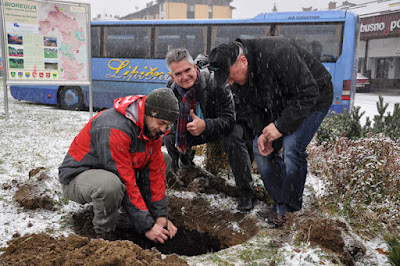
Planting of Apple Tree in Zreče – December 2009

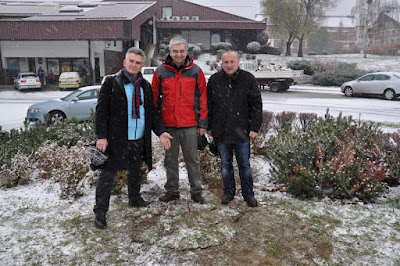
An apple tree marking the fraternal friendship between Sedbergh and Zreče was planted in Zreče in December 2009.
 

A little bit of Sedbergh now grows in Zreče, Slovenia – outside the bus station in the town centre – so that young people going to school can grab an English apple off the tree to give to teacher – or at least they can in about 10 years time.

An apple tree from Zreče apple tree grows outside the Howgills Bunk Barn in Sedbergh by the public footpath where many walkers have already enjoyed the fruits of our twinning.

May the friendship between our towns always be fruitful – naj naše prijateljstov vedno rodi sadove!

In the photos are Zreče mayor Boris Podvrsnik, Zreče town band manager Slavko Kejzar, and Sedbergh’s Town Twinning Cultural Commissar David Burbidge. Photos by Urska Firer.

Town Twinning and International Achievements

Achievements
 

Wherever an event or a visit goes towards fulfilling one or more of the following aims it has been an achievement for Sedbergh. The event or visit:

• provides an opportunity for the community to look outwards
• helps stimulate business ideas and openings
• gives opportunities for the more disadvantaged members of our community to broaden their horizons
• raises Sedbergh’s profile nationally and internationally
• periodically at least, livens up the town a little
The people of Sedbergh who come into contact with others from overseas have the privilege and opportunity to learn about a different culture and way of life.
The coming together of people across Europe and the close relationships and hand of friendship should always bind us in peace and prosperity.

Rationale for Town Twinning in Sedbergh

 
Most town twinning arrangements were set up following the Second World War. Town twinnings and partnerships in Europe were a way of building friendship, bringing together people who had fought on opposite sides and of consolidating existing alliances. The concept of twinning began in Europe as early as the turn of the last century, with the first recorded UK link in 1920 between Keighley, West Yorkshire and Poix du Nord in France. The number of twinning links increased significantly after the War to aid the process of peace and reconciliation. They grew in number and flourished as young people came and went across the Channel. A second wave of enthusiasm for town twinning took place in the 1970s and 80s, following the UK’s entry into the European Economic Community.

Town twinning in Sedbergh is seen as a concept that includes the friendship-and-understanding aspect of many twin-town arrangements in the past and goes beyond that into more 21st-century objectives. Our aims in Sedbergh are:

•  to provide an opportunity for the community to look outwards
•  to help stimulate business ideas and openings
•  to give opportunies for the more disadvantaged members of our community to broaden their horizons
•  to raise Sedbergh’s profile nationally and internationally
•  periodically at least, to liven up the town a little

Since the first UK international twinning arrangements in the 1920’s, and their rapid growth in the 1950’s, town twinning, or sister cities as it’s sometimes called, has passed through a number of phases in terms of people’s general perception. Currently, it is seen as a positive activity within and by the EU.

The EU website page, Twinning Towns for Unity is positive, if somewhat hard to get a grip on: ‘EU support for town twinning injects a structuring effect and strengthens the strategic direction, as well as the European content, of such activities.’

We in Sedbergh are developing our town-twinning goals. We have achieved each of the above five bullet-pointed aims to some degree. A challenge that remains is business ideas and openings, see Town Twinning and Economic Development. The other four aims have been satisfyingly moving forward, in particular with regard to school and musical exchanges, of which there have been a number each year since our town twinning arrangement began (see topics list on left).

Sedbergh began to look at finding a twin town in 2001 following the economically-depressing effect of the 2001 foot and mouth crisis (see Why and how we entered into twinning). Twinning was one idea for helping stimulate economic development; see Town Twinning and Economic Development.

Sedbergh Town Twinning – Economic Development

Economic Development Aspects of Sedbergh’s Town Twinning Initiative
 
No community, be it a place or a company, ever develops by looking inwards. It needs to look abroad; be ready to take on new ideas; to understand what others of similar type are doing and how they are doing it. If it does not do that then it puts itself at risk of being left behind, or at the very least of not knowing whether it is being left behind or not.

By looking outwards, contacts are made, ideas are assimilated, mistakes and shortcomings identified, and as a result, in a way that is often surprising, you find yourself getting bigger; this applies to a community as much as it does to a business.

There is nothing scientifically advanced about this – it’s what successful organisations have always done. Looking outwards stimulates growth.

It is not the job of a town-twinning arrangement to open up new markets for a local product overseas direct, that should be the job of the individual businesses or local trade organisation; more that initiatives raise awareness of what an overseas community of similar type and problems produces and by planning events the local community can, among other things, help boost the occupancy figures of the guesthouses and B&Bs. The twinning partnership is there to help the community gain a wider view.

The economic development success is indirect. Look outwards. Learn about the ways of others. (see Look Outwards. Learn Others’ Ways.).

History of Town Twinning in Sedbergh

How and Why We Entered Into a Twinning Arrangement
 
Sedbergh decided to look at the possibility of finding a twin town in 2001, eventually signing its first twin town charter, with Zreče, in May 2005. During that time we were the focus of a television programme. Here is a brief history of how Sedbergh’s town twinning arrangement came about.
2001 and the ‘Foot and Mouth Crisis’

2001 and foot and mouth disease strikes Britain. Foot and mouth is a virulent virus affecting sheep, cattle and pigs and its affect on the ecomony of the country, and on rural areas on the country in particular, was severe. There is a UK government website dedicated to the subject, http://footandmouth.csl.gov.uk/

The widespread slaughter of livestock resulted in images on television of fields of burning carcasses – disposal of so many diseased and deceased animals being understandably not that simple a job. Although the disease does not seem to affect humans in any physical way, it does in a psychological one, and the distress of farmers and those in rural areas caused prime minister Tony Blair to be forced to postpone a planned general election, evidently to his chagrin (see Guardian Politics, April 2nd 2001).

Foot and mouth disease never came to Sedbergh. No animals were slaughtered here. But the signs of closedown were manifest everywhere. There were symbols of exclusion such as disinfectant mats for vehicles to drive over on leaving the motorway, and notices telling people not to drive on by-roads, and all the footpaths were closed including, for a while, those where no livestock would be likely to set foot (and certainly not mouth).

Farming was of course affected, as farmers were disallowed from moving, and hence selling, their livestock. And those people who ran tourism-related businesses found their customers dwindled, both in terms of visitor numbers falling off and in diminished sales of leisure-related goods such as walking boots.

Images such a disinfectant mats for vehicles, while intended in some way to support the farmers, had the opposite effect, giving the message that the countryside was diseased.

Sedbergh needed a boost

Foot and mouth disease was declared eradicated towards the end of 2001, but this did not lead to jubilation in the streets. One reason for this is that it had taught us something; it had taught us that the economy of our town was fragile. No one could be sure that the problem would not soon recur, and if it did what could be done to minimise its effect. An image of fields of burning animals, even if in Sedbergh’s case it wasn’t a reality, was not good for business. The town needed something to boost its self-regard.

A number of options considered

When foot and mouth disease was declared eradicated, sub-groups of members of Sedbergh Chamber of Trade got together to see what could be done to lift the town's spirits and, above all, to get economic regeneration kick-started.

We filled flipcharts with ideas of what might constitute an initiative for economic generation, and with some argument and a bit of agreement, the list was narrowed down to about eight possibile initiatives that might be achieveable and that might have potential.

Two initiatives gained enthusiasm – one was to look at town twinning

Coming up with an idea is one thing, putting it into practice, in terms of time and money, is another. And there was the question of whether the idea would actually achieve anything to make the town feel more optimistic about itself at all.

Two of the ideas seemed to be key candidates for doing something positive; one was to give Sedbergh a focus by which it might become known as identifiable as different from elsewhere, a brand if you want to put it that way, and hence was born Sedbergh Booktown, which you can read more about on Sedbergh Booktown. The other initiative that came out as a viable one was town twinning.

Why town twinning?

The initiatives for economic generation were the result of work by the Chamber of Trade. Business people, or some of them anyway, have learned that when you are faced with a problem, one of the things you can do is to look outside, look what others are doing, and see if there is anything that can be adapted to your circumstances.

In doing this research, it isn’t usually much help to contact people who are in exactly the same position as yourself, because they are not likely to have any better idea of what to do than you. Far better to try and broaden the horizons.

Early on in this, we quickly discovered something: that of the two-and-a-half-thousand or so twinning arrangements between British towns and those overseas, just five, yes five, were from towns in the county of Cumbia. Did we in our region know something that the other’s didn’t? Or were we missing out on something here? We had a horrible worry that it might be the second.

Town twinning, which has a well-established infrastructure in place, seemed to be an opportunity to broaden the town's horizons.

Having decided to establish a town twinning arrangement, how should we begin to find a town to twin with?

Where should we look for a town to twin with? Some said France. France is our nearest neighbour and our children should learn more French. Others favoured Holland. Of the foreign car number plates we see around the district in summer, by far the largest number are Dutch. Various other countries were mentioned, influenced sometimes by individual people’s favourite holiday destinations.

What we actually did, first of all, was to erect a flipchart, and on it we wrote different people’s answers to the questions: ‘What do we want from this?’, and ‘What could be the synergies that might make this worthwhile?’.

We drew up a list of about seven or eight things that Sebergh is strong at and would be keen to develop. At the end of this we had our community-inspired twinning checklist.

Next, we put our town’s CV on the websites that existed at the time, for towns looking for a twinning partner. We also looked at other towns already on the list, to see whether there were any that seemed a suitable fit, but we couldn’t find any.

Sedbergh’s strengths and identity

Sedbergh has four schools: a long-established and well-known public (ie private or independent) school, a state primary school for children up to the age of 11, a state secondary school for 11–16s, and a residential school for boys with educational and behaviour difficulties. Sedbergh is strong on schools.

Sedbergh is a bookish and musical place. Even before becoming England’s first official book town, there were a number of bookshops and reading and theatrical groups, together with a town brass band, several singing groups, and an annual music festival.

Not all that big on sport, though there are thriving football teams and tennis and bowls.

Lots of shops for a town of its size, and a feature is that people worry about how long this can continue.

And then there are the two industries that, if you aked people what it was were the mainstay of the town, many would identify: farming and tourism. Farming is in severe decline and no one knows quite how to reverse this, and tourism has the problem shared by thousands of other places throughout the world, who also believe that their area is second to none, which is how to attract fewer visitors, with more money to spend (sometimes expressed as attracting more visitors).

A small town in Germany

As so often happens, when you’ve set in train the mechanisms for achieving something, someone comes along and says, ‘There’s a friend of mine who . . .’, and that was exactly what happened. A friend of a friend of someone who knew someone mentioned a town in Germany that was looking for a town twinning arrangement, and so closely did the twinning committee of the German town think that Sedbergh might fulfil their matching checklist, that a group of people from that town was coming over to visit. Of course, we did our best to be hospitable, and arranged visits to local points of interest and dug from the woodwork all our German-language speakers (there are quite a number) and arranged receptions, one of which was in the pub where Dennis, one of our local police officers, appeared in his uniform and said, “’ello”.

And then there was a reciprocal visit to the town in Germany, to which we took a representative from the regional twinning association, Jürgen, whose birthplace is Germany, and we were entertained most hospitably and went to a party in a beer tent and did a speech during the interval and Jürgen, on returning from the beer tent to his lodgings after the party, went behind a tree to relieve himself and disappeared, slowly like a sinking ship, down a hole in the ground he hadn’t spotted in the dark and broke his leg quite seriously and was in hospital for quite some time afterwards and all were concerned that he may never be able to walk normally again, and we thought that surely this must be propitious, and there were so many similarities between the concerns of this small town near Heilbronn, and Sedbergh, that all seemed to be going swimmingly.

The telly

The camera and jolly sound man arrive in Sedbergh

And then along came . . . the telly

Shortly after visiting our potential twin town, in summer 2004, we received out-of-the-blue an email from a television production company, saying that they were preparing a twelve-part series on town twinning, and that they might consider Sedbergh as the focus in the UK.

Representatives from the television production company came to Sedbergh during a sunny few days and met various people in the pub and seemed to think we might be quite a telegenic place.

We told them about our budding arrangements with the town in Germany but they said that set-up jobs would be seen through by the great television-watching public and that we should have to be introduced to places, which we were not told even the name of beforehand.

This is an unconventional approach to finding a twinning partner, but on the other hand the town felt that it could not reject the opportunity for some exposure on national television, and we therefore put our position to our new-found German friends, who kindly understood the dilemma we were in, and so to Sedbergh came the arrival of the cameras. You can see a description of the presence of television cameras in Sedbergh here.

Sedbergh sets up a formal town twinning arrangement with Zreče

The activities put in place by the television production company resulted in a pulling-together of the people of Sedbergh, the like of which had not been seen in anyone’s memory. The number of people who voted for a twinning arrangement with Zreče exceeded the votes given to all the other candidate towns put together, and the number of people who voted was greater than the number who turn out for most general and local elections.

A formal twinning charter has been signed and reciprocal visits are regularly underway.

In Britain, at least, Slovenians come with no baggage. Everyone likes a Slovene. The twinning arrangement between Sedbergh and Zreče has so far been a huge success. A satirical song dating from the 1950s includes the words: ‘The whole world is festering with unhappy souls. The French hate the Germans and the Germans hate the Poles. Italians hate Yugoslavs, South Africans hate the Dutch. And I don’t like anybody very much!’ †. Fortunately, so far as we know, we have no Slovenophobes, in Sedbergh.

† lyric by Sheldon Harnick, who also wrote the words to Fiddler on the Roof

Speaking Slovene

Some thoughts on the Slovene language from David Burbidge, organiser of numerous exchange singing events.
 

There are many who say that Slovene is a very hard language to speak – my experience has been the opposite, it must be one of the easiest.

I’ve never been good at languages. I put it down to a crippling experience in my early teenage years. My father worked in the United Nations and clearly thought that speaking more than English was a good thing. So I was packed off to stay with Vincent Roland in Paris for the summer. On arrival I tried out my creaky schoolboy French: ‘Bonjour. Je m’appel David. Comment allez vous?’ And was greeted by guffaws of laughter and: ‘I think perhaps we speak in English – your French is terrible.’

So what makes Slovene so easy to speak is the enormous ammount of encouragement you receive if you say anything more than hvala (thank you) or dober dan (good day). I try out my growing list of phrases which started with those gleaned form the Berlitz phrase book: Kako cudovit dan (what a wonderful day) and Bi kay popili? (can I get you a drink) and moved on to even more useful proclamations: Naj bo vasa casa vedno polna (may your cup always be full) – and the results are either total delight or total incomprehension (can an Englishman really be speaking Slovene?) But never scorn.

The reasons why there is this myth about Slovene being a difficult language and why there is so much encouragement to learn it are, ironically, the same. With only 1.8 million people in the country Slovene is not very widely spoken throughout the world. And most people having enough spare time to learn a language tend to choose the ones where there are countless millions of people to communicate with.

And the Slovenes, being essentially a polite and thoughful race of people, let people off the hook by telling them that the language is far too hard to learn anyway.

Je Skomarskih Ofarjev – a song about a pig
Je Skomarskih Ofarjev is a song by the famous Zreče poet Juri Vodovnik about a pig who hides in an old house which the villagers use as a toilet, because the mushrooms are so good there!

What I think is this: if it is so hard, how come that all the tiny infants and children in Slovenia speak it? And also, if there are only 1.8 million people speaking it then the more people who learn it the better – there’s already far too many people speaking in German, French and Spanish.

Although, having said that, the grammar for Slovene is not easy – there are different endings for everything, not just for singular and plural but also for if you are speaking to two people. (Though every language has its hurdles. How people learn English with grammatical constructions like one cow, two cows – and then, one sheep, two sheep – is a mystery to me.)

Personally I find it easier to sing Slovene than to speak it. Our group in Sedbergh has been learning some of the Slovene songs, most of which tend to be very sad love songs. Like Nocoj pa oh nocoj (Tonight oh tonight, when the moon shines over the earth, I will leave – but don’t cry my love, I will be back in seven short years.) But also lively drinking songs like Kolko kaplic tolko let (May God grant you as many years in your life as there are drops of wine in the glass).

And the wonderful national anthem which translates as:

God’s blessings on all nations who long and pray for that bright day,
When over earth’s habitation, no war, no strife, shall hold its sway.
Who long to see, that all men free, no more shall foes but neighbours be.

Being the seventh verse of a long poem by the national poet France Preseren called the Toast, in praise of wine, women and camaraderie. And the only national anthem in the world to advocate world peace rather than national glory.

The advantage of having a healthy repertoire of songs is that I am now able to communicate the odd line when appropriate. So when I am leaving a company of Slovenians with friends I turn to them and say: Pojd’mo veselo domo (let us go joyfully home) – from the lovely old song Vecernica (Evening hymn).

The Cautley Carollers in Medved
The Cautley Carollers met with the Skomarje singers in Medved – along with the Mayor and the president of Unior who both made some fine speeches. We all sang Zivijo together, the pace slowing down with every toast.

And from the same song I am able to comment on beautiful sunsets: Glejte ze solnce zahaja, skoraj za goro bo slo (look at the sun setting over the distant hills). A translation of an Ali Burns song – May your cup always be full – has many useful lines for greeting and toasting like: Zelimo vam veselja in zdravja in ljubesni in vecni mir (we wish you joy and health and love and peace for ever) though it’s not so useful when shopping at a supermarket or haggling over the price of a taxi ride.

Other phrases come from asking my long suffereing Slovene friends for translations. So when I was asked how I like being back in Zreče recently I was able to reply: Vreme je lepo in toplo kot se srca Zrečanov – (the weather is beautiful and warm like the hearts of the people of Zreče).

I have been organising cultural exchanges and performance projects between singers from Sedbergh and singers from Zreče for the last couple of years and have found that the best events were the ones where most people didn’t speak the other’s language.

Oscar Wilde put his finger on it when he said that America and England were two countries divided by a common language. Language is so much more than the mere words – behind everything we say there are layers of meaning which are tied up with our culture and our history.

So when the Zreče youth choir visited Sedbergh and were singing in the mediaeval market fair they met the Fool, the court jester, sitting on a pole in the middle of the street. ‘Ah here come the Slovenes, you can smell them.’

The Odmev Quartet from Zreče
The Odmev Quartet from Zreče singing in Rydal Caves with the Lakeland Voice singers one wintry night in December 2005. The acoustics were terrific. Everyone had learnt some Slovene phrases, and especially Bi kaj popili? – which was very useful when we all went to warm up and continue our singing in the Badger Bar.

Now as a straight translation this is nothing but a terrible insult – what a dreadful thing to say! But the wider context around the court jester being the only one who could insult the king, and his role as the one who makes everyone feel a bit uncomfortable, gives a different meaning. (Although personally I was quite ready to kick him off his pole.)

Similarly, when the Scottish football players were recently visiting Slovenia and walking down Celje high street in their kilts singing and happy after having won the match, the Slovenes all said how much they liked them. ‘Yes, we were calling out to them how pretty they looked in the skirts.’ Fortunately in Slovene rather than in English. I have known Scotsmen who had been told something similar in England and had never returned south of border again.

And when the Ljudski Pevci iz Stranice (folk singers from Stranice) came to Sedbergh, none of the singers spoke any English at all. But that didn’t stop Ivan getting into a very long conversation with Vivienne Postlethwaite in her shop, both in their native tongues, neither of them worried that they didn’t understand a word the other said.

The Odmev Quartet from Zreče in the Sportsman’s Inn
The Odmev male voice Quartet joined us in the Sportsman’s Inn for some more singing – 150 people all joining in on the choruses, and even some Balkan dancing in the back room. A night to remember.

Afterwards Ivan told our friend Igor Cvetko, a Slovene ethnomusicologist who speaks perfect English, that Ivan had had such a good time that he wanted to take her home and marry her!

There has been much research which suggests that communication has little to do with the actual words – some people say as little as seven per cent – and everything to do with the tone of voice, facial expression, and body language.

When we visited at Christmas and drove a minibus on the right for the first time we managed to upset several other drivers who saw our number plates and thought we were Italian. Their gesticulations really needed no translation. Though it was interesting that when we translated the number plates with the addition of GB stickers, the rude gestures changed to friendly waves.

And there is also the point raised by a Irishman I heard on the radio recently talking about his countrymen’s fame as talkers: ‘It’s said that Ireland is a nation populated by warm hearted people talking to each other’, he said describing typical people meeting to talk in the emerald isle. ‘But my experience is that they are a nation of warm hearted people talking to themselves. Few people bother to listen to each other.’

Perhaps there is something of that in all of us.

I recently attended a meeting of Slovene poets in the hilltop village of Skomarje, in the Skomarski Hisa – the old house where Zreče’s most famous poet Juri Vodovnik lived. The poems were all written by the people who read them, about love, and loss, and hope – the poets’ themes. I sat listening to the music of their voices, not particularly troubled by understanding only one word in every fifty.

And then someone read a poem by Robert Frost – and the extraordinary thing was that it was no different – I still couldn’t understand a word, but took great delight from the music of the words and the drama of the setting.

But I continue learning my phrases and my songs, because it gives me as much pleasure as it obviously does our Slovene friends to be able to say something in the language of this beautiful country. So . . . Se eno si zapojmo.

David Burbidge

A video with some basic phrases useful when visiting Slovenia.
Slovene language courses in Sedbergh take place each year.
See comments from His Excellency Iztok Mirošič, Ambassador of the Republic of Slovenia, (2008).

Visit to Sedbergh by the Slovenian Ambassador to the UK

His Excellency Iztok Jarc Visits Sedbergh
 

Tuesday 7th July. His Excellency Iztok Jarc, the Slovenian ambassador to the UK, together with his wife, Helena Jarc, and two members of the consular department from the embassy, Ms Mateja Ŝtrumelj Piŝkur and Mr Matej Zakonjŝek, arrived at Oxenholme station on a train from from London, to be greeted the mayor of Kendal, Coun John Bateson, station manager Stephen Reynolds, Sedbergh twinning officials Garth Steadman, Susan Garnett and David Burbidge, and a 45-piece band from Slovenia playing the Slovenian national anthem.

While the band went to give a public performance in the centre of Kendal (see The Zreče Community Band Visit Sedbergh), a lunch of welcome was held in the Cross Keys at Cautley where the leader of Sedbergh Parish Council, Vic Hopkins; the head of the Sedbergh Booktown project, Carole Nelson; the secretary of the Sedbergh Town Band, Hilary Hodge; the head teacher of Sedbergh School, Christoper Hirst; the head teacher of Sedbergh Junior School, Sara Hirst; the head teacher from the state primary school, Sedbergh Primary, Maggie Cullen; and the head of languages from the state secondary school, Settlebeck High School, Alison Brown; together with members of Sedbergh’s town twinning group, were host to the ambassador and his party together with the Mayor of Zreče, Mr Boris Podvrsnik. This lunch meeting was well-reported by all the Sedbergh people present as consisting of useful and stimulating discussion, in particular the learning about what the embassy does and plans to achieve, and about economic conditions and developments in Slovenia.

A FARM VISIT AND A CONCERT

After lunch the ambassador and his party, together with Mr Podvrsnik, were taken to the farm of Thomas and Barbara Gorst at Mutton Hall to see and hear about the raising and economics of cattle and sheep on a hill farm.

In the evening there was a concert in Powell Hall of Sedbergh School with Sedbergh’s town brass band and the Zreče Community Band that included some renowned Slovenian musicians and singers, see The Zreče Community Band Visit Sedbergh

David Burbidge

See more videos of the tour at www.youtube.com/davidburbidge

Zreče Twinning Praised by Diplomats

Representation at the Slovenian Embassy in London
 

The twinning between Zreče and Sedbergh has been so successful that other towns in England and Slovenia are now looking to use the two towns as a model for their own twinning initatives.

David Burbidge

David Burbidge

In June 2008 Sedbergh resident David Burbidge was invited to a reception at the Slovenian embassy in London celebrating Slovenia National Day and the end of Slovenia’s term of office as president of the council of the European Union. David, who has organised over a dozen cultural exchanges between Sedbergh and Zreče plus work experience opportunities for visiting Slovene students, the only part-time Slovene language course in Britain, and a Slovene folk song society, was invited to join international diplomats and high ranking officials at the reception.

‘It was fantastic,’ said David. ‘All of the diplomats had heard about the twinning between Zreče and Sedbergh which is surprising because Sedbergh is very small really. But I think some of them thought it was bigger than it is because I was introduced as ‘the Ambassador of the Yorkshire Dales’ and asked if our embassy was in Sedbergh.’

‘Slovenia’s Ambassador to the UK, Iztok Mirošič, who has been to Sedbergh twice to meet singers from Zreče, was very kind and when he shook my hand asked me to send his best wishes to the people of Sedbergh. I also met other people who are planning to twin with towns in Slovenia who were asking for advice about how to go about it. This included the Slovene Consul in Edinburgh who has plans for a partnership between the Scottish Cairngorn mountains and the Triglav National Park, and the Cornish town of St.Ives with Medvode.’

The Ambassador also wrote a very encouraging letter to the Slovene language class in Sedbergh praising them for their efforts. The class, which was approaching the end of its first term had been helped by Urska Firer in Zreče who received a surprise telephone call one Monday night from the students who introduced themselves and talked to her in Slovene. Afterwards Mr. Burbidge described her as ‘zvezda učiteljica.’ (star teacher).

Other Slovene influences in Sedbergh include a Potica-making competition, where people throughout the town were attempting to make Potica, from a Slovene recipe book, to be judged by visiting Slovenes. The Sedbergh Slovene language students would be baking the first batch for an earlier visit from a Slovene Embassy official to taste their attempts. ‘If he drops dead we will have to change the recipe for when the singers come from Zreče in August,’ said Mr. Burbidge.

The Sedbergh town notice board is also the first notice board in Britain to have notices in both English and Slovene, as well as extracts from the Zreč’s local newspaper ‘Novice’ about school visits to Zreče, accounts of the singers’ exchanges, and photos of many of the people from Slovenia who have visited Sedbergh. Three large signs alongside the main roads into Sedbergh proudly welcome visitors to Sedbergh ‘Twinned with Zreče, Slovenia.’.

‘Many of us in Sedbergh like to think that although our twin towns are thousands of miles apart, our hearts are so close together that it is like we live next door to each other,’ said Mr. Burbidge. ‘And although we don’t know everyone in Zreče yet, we like to think that nobody there is a stranger – just a friend we haven’t met yet.’

How to Make Potica

Potica – Slovene Festive Cake
 

Those who have been to Slovenia will know that two of the most common delicacies to be offered to visitors by way of hospitality are the blueberry brandy known as Borovničevec, and the festive nut cake Potica (pronounced Paw-teetsa).

Now we have the chance to enjoy some traditional Slovene cuisine at home with this recipe for Potica.

Ingredients
  • Dough:
  • 600g flour
  • 40g yeast
  • 2 tbsp lukewarm milk
  • 2 tbsp flour
  • 1 tbsp sugar
  • 2 egg yolks
  • 50g butter
  • 50g sugar
  • 300 ml milk
  • peel of one lemon
  • salt
  • Filling:
  • 400g walnuts
  • 200ml milk
  • lemon peel
  • 1 tsp cinnamon
  • 2 tbsp rum
  • 100g sugar
  • 100g honey
  • 2 egg whites
  • 40g butter

Sift the flour into a bowl, cover and put in a warm place. Prepare the yeast: mix fresh yeast with two tablespoons of flour and a teaspoon of sugar then stir and allow to rise in a warm place. In the meantime, the fat, egg yolks or whole sugar. Warm the milk gently, grated lemon peel and the mixture of fat, eggs and sugar; to cool. Make a dough from warmed flour, milk and yeast (do not use all the milk at gradually and only if and necessary.) Knead and beat dough until it no longer sticks bowl, then cover it with a put it in a warm place to rise

In the meantime, whisk the fat, egg yolks or whole eggs and sugar. Warm the milk gently, add salt, grated lemon peel and the prepared mixture of fat, eggs and sugar; allow to cool. Make a dough from the warmed flour, milk and yeast mixture (do not use all the milk at once, add it gradually and only if and when necessary.) Knead and beat the dough until it no longer sticks to the bowl, then cover it with a cloth and put it in a warm place to rise.

A recent Potica baking competition in Sedbergh led to this cartoon appearing in the Zreče newspaper

A recent Potica baking competition in Sedbergh led to this cartoon appearing in the Zreče newspaper Novice, showing a Zreče cook asking “Was it a success?”, to which the Sedbergh cook replies “Well I know how to say Potica, I just don’t know how to make it!”

While the dough is rising prepare the filling. Pour the milk into the pan, add the butter and half the sugar and bring to the boil; use the hot mixture to scald the walnuts. Warm the honey separately and add it to the walnuts, together with the grated lemon peel, cinnamon and rum. Let the mixture cool. Beat the egg whites and the remaining sugar until hard and fold carefully into the filling.

When the dough has doubled in size, roll it out to the thickness of one finger. Spread the filling over it and roll into a tight roulade, then place the Potica in a greased baking tin. Allow to rise again in a warm place.

Whisk an egg, spread it over the cake and bake for approximately one hour in a preheated oven. When it is done, remove the potica from the baking tin immediately to prevent the crust from becoming moist and breaking away from the rest of the cake.

Climbing Triglav

The ascent of Triglav, Slovenia’s highest mountain. By David Burbidge, organiser of numerous exchange singing events.
 
Triglav

The summit of Triglav in the distance. The name Triglav is from a three-headed mythological beast who was said to inhabit the triple-headed summit.

It is said that every Slovene has a national duty to climb Triglav, the nation’s highest mountain, at some point in their lives in order to become a true Slovene.

Although I am only a humble Brit – and no amount of mountain climbing will ever help me to attain the lofty goal of Slovene national – it was still a challenge and an invitation I couldn’t refuse. Or as the beer advert says: “Skusnjava ki se ji ne morete upreti” – the temptation which I cannot refuse.

So it was that I hopped on to my trusty steed – my Ljubljana Senior bicycle bought in the capital for the princely sum of £7 – and rode out of Zreče into the sunset whistling Vecernica (Glejte ze sonce zahaja – see the sun setting) . . . and to the station at Celje to catch a train into Ljubljana. I stayed at the Celica hostel where I led an English folksong workshop in return for one night’s accommodation – and then the following morning caught the 7am bus to Bohinj – the beautiful glacial lake surrounded by awe-inspiring mountains and waterfalls in the western Alps.

Mountain path

Mountain path showing some of the extraordinary wild flowers that grow in the limestone in the valley of the seven lakes. The paths are easy to find because they are all sign-marked by what look like red and white targets.

At 9am I was at Hotel Zlatorog, and after borrowing a walking staff and drinking a cup of coffee I was off through the woods. Mountains in Slovenia aren’t like English mountains – you walk through forest for most of the way up until you are too high for trees to grow. Which can be very pleasant on a hot day when all you crave is shade.

At last the beech trees gave way to an upland valley – the Dolina Triglavskih Jezer – and the seven lakes shining like jewels. I stopped at the koca pri Triglavskih Jezerih – a mountain refuge and café – where the chef was a vegetarian and delighted to welcome one of her kind for lunch.

Then up past a naked Slovene diving into the icy waters watched by his countrymen. ‘Typical crazy Slovene’, they said, before telling me that on the summit I would find several of the country’s ministers and politicians. ‘There’s not many honest men on Triglav today,’ they said. I told them about our very own Guy Fawkes, said by many to be the only honest man ever to enter parliament.

By the time I was reaching the Hribarice pass there was very little vegetation – just barren rock like the surface of the moon. The sun was brilliant on the limestone but as I was not wearing a hat it took its toll – blinding headaches and nausea, and I knew I was getting heatstroke. I changed my plan to sleep at Kredarica and instead just made it to Dolic (the Trzaska koca) in time before the mountains were lost to the darkness.

There was no bed for me – but I was told to wait, as sometimes people booked and couldn’t make it – like I had at Kredarica. So I sat shivering and drinking several litres of water getting my health back. By the time I was given a bed I was better and ready for the evening meal they served – along with very welcome beer.

These mountain refuges are an unusual experience. They don’t turn people away – so once all the beds have filled up, the remainder seek other places to lie down. In the early morning I rose at 5am to start my ascent of the summit and found every space filled with bodies – the floors of the corridors, the benches of the dining room, even on the tables and underneath – people still snoring away as we ate our omelettes and the old men at the bar drank their Schnapps to kick-start the day.

On the summit of Triglav

David Burbidge on the summit of Triglav

I could see why Schnapps might come in handy once I started my ascent – the rock-face is vertical and though the footholds are solidly embedded into the rock-face, the drop below is hundreds of feet into certain death. And above were people unused to climbing mountains, kicking stones down with a cheery cry of warning.

I tentatively made my way up to the top – being humiliated by a band of school children clipped to the metal rope and wearing crash helmets, moving like lizards across the rock and past me.

And then I was there – along with what seemed like half of Slovenia. Scouts getting their stamps in their books to show they had made the summit. A queue to get a photo taken on the top. Even an enterprising man who had dragged up a rucksack full of beer and had set up a summit bar on a plank of wood.

The views are fantastic – all the way into Austria and Italy – another good reason to go there early in the morning before cloud can obscure the summit. Even better for having climbed there – or as Goethe says: ‘The outward form of the mountain can be seen by anyone – but its innermost beauty can only be appreciated by those who have contributed part of themselves.’

Mass at the Kredarica hostel

Mass at the Kredarica hostel with bishops and Government ministers who had been flown in by helicopter. The mountain behind is a different kind of summit meeting – Triglav, over 9,000 feet high.

Coming down I could hear church choirs &ndasgh; and by combining Masa (mass) with Ubit (dead) was able to get some wry smiles. And perhaps it was not so ironic – every few yards there was a shrine to some departed friend or family who had perished on the mountain – some of them displaying the extraordinary Slovene flair for creating art wherever they are.

The singing turned out to be a church service at the Kredarica chapel – attended by bishops and ministers who had been helicoptered in for the occasion.

And then down – in one day – to a long valley road past stunning waterfalls through the forest – the Dolina Mosticna – and then the longer road back to Kranj and Ljubljana.

I had missed the bus home so instead put my thumb out and within minutes had a lift most of the way. And then just a few minutes later the skies opened and an ocean fell from above – the celebration drumbeats on the car roof like applause – maybe not a true Slovene, but worthy of congratulations for my climb to the roof of Slovenia.

As Tom Longstaff, President of the Alpine Club in London, says: ‘Triglav reigns over a dreamworld sundered from time, full of unbelievable hidden nooks, of unsuspected passages, of sudden visions of cliffs which cannot be real. Surely there is no other mountain land like this.’

David Burbidge

Signing of the Twinning Charter – May 2005

First Official Twinning Delegation Visit to Zreče
 
The Chairman of Sedbergh Parish Council, Mr Alan Pratt (left), and the mayor of Zreče, Mr Jože Košir (right), signing the charter.

The Chairman of Sedbergh Parish Council, Mr Alan Pratt (left), and the mayor of Zreče, Mr Jože Košir (right), signing the charter.

The signed town twinning charter.

Following the BBC TV series The Town that wants a Twin, Sedbergh and the Slovenian town of Zreče signed a formal twinning agreement. A delegation from Sedbergh comprising Alan Pratt (the Chairman of Sedbergh Parish Council) and his wife, Dorothy, Garth Steadman (Chairman of the Sedbergh Twinning Committee) and Parish Councillor Vic Hopkins travelled to Zreče for the ceremony. The small but moving ceremony to commemorate the formal twinning of Sedbergh and Zreče was held in a small local museum called ‘Skomarska Hisa’, an old house in the pretty village of Skomarje situated in the mountains overlooking Zreče on Friday 27th May 2005.

The Ljudski Pevci folk singers, who had recently visited Sedbergh, were also there as well as a local children’s singing group. Prior to the signing these groups entertained those present with folk songs and poetry. The children’s interpretation of a local poem was particularly entertaining and everyone was touched by their commitment and enthusiasm.

The community of Zreče was represented by the Mayor, Mr Jože Košir, Zdenka Kejzar (tourism officer) and Barbara Potnik as interpreter. Local TV and newspapers covered the ceremony.

The Mayor welcomed the Sedbergh delegation and spoke of the great benefits that he saw emerging from the twinning. Mr Pratt responded in a similar vein, saying: ‘The twinning of our two communities provides a great opportunity for the residents of both communities to get to know and understand each other and their cultures’. He went on to say a few carefully rehearsed words in Slovenian to the delight of all present. Mr Steadman also spoke of the benefits of commercial contacts between the two towns, and Mr Hopkins, on behalf of Sedbergh Parish Council, presented the Mayor with framed print of Sedbergh by local artist Hilary Moore.

The charter was then officially signed by the Mayor, Mr Pratt and Mr Steadman after which toasts were drunk in local wine with some local food delicacies. Finally the Ljudski Pevci folk singers broke into song and the whole party moved to a nearby tourist farm, where after enjoying the breathtaking views they shared a celebratory meal. Mr Pratt summed up the feelings of all those present at the ceremony when he said: ‘This has been a memorable day for the two communities and I have no doubt it will lead to closer links between us in the future’.

The Story of the Town that Wants a Twin

How Sedbergh Came to Feature in a Television Programme
 

During September and October 2004 the television cameras were in Sedbergh, filming a twelve-part series on town twinning that was broadcast on BBC2 in January 2005 under the title, The Town That Wants a Twin. (You can read about the history of Sedbergh’s town-twinning intiatives here).

A televison production company comes to visit

One day, quite unexpectedly, an email arrived from a television production company saying they were thinking of producing a series of programmes about town twinning and would we be interested in talking to them about this?

On the premise that there is (said to be) no such thing as bad publicity, we felt the answer had to be yes. Representatives of the production company visited Sedbergh on a number of occasions on each of which the sun happened to be shining in a clear blue sky, and after meeting a variety of local people in the pub and seeing the photogenic scenery, the production teams said they thought that Sedbergh was just the town in the UK to focus the proposed programmes on.

Sedbergh is chosen to feature in a series

There were a number of conditions upon which the television production company would come to Sedbergh to film their programmes.

  1. We should not be involved in any existing town twinning arrangement, and since we already were close to making an agreement (with a town in Germany, see A Small Town in Germany on How we Entered Into a Twinning Arrangement) we had to suspend our existing town twinning initiatives.
  2. We were not allowed to know which towns were coming to visit us until immediately before their arrival, when a video presentation, made in the locality that was soon to arrive, would introduce the visitors to us.
  3. People from the visiting town would work alongside their counterparts in Sedbergh: a butcher working with the butcher; a farmer working with one of our farmers; an estate agent working alongside one of our estate agents, and so on, and be filmed in the process.

This was, and is, an unconventional approach to town twinning – not one that appears in the classic case studies – however we were advised that it would make for good television.

Four towns are invited to meet us
We were told of the dates that each of four towns would come to visit and that the visitors from each town would stay for a week, though we were not told in advance which towns they were. On a prescribed date, we were shown a video presentation made by the visiting town – everyone in Sedbergh was invited to the video presentation – and then some days afterwards, the bus bringing the visitors from the airport was due to arrive, and we were to provide a welcome party.
Throughout the week of a town’s stay, various activities were to be put on, mostly suggested by the production company teams, activitiesd that involved joint participation by the visitors and local people. These activities would be filmed.
Wine and food tasting in Garth Steadman's butcher’s shop

Wine and food tasting in Garth Steadman's butcher’s shop

First town, Eymet, France

The visitors from Eymet were at a distinct disadvantage over the others. They came first, which meant that we were unpractised in receiving a visiting town, and they came when the schools were still on their summer holidays, which made for little or no involvement by young people.

But we did our best and events were arranged (ie suggested by the production teams) including pillow fights in the swimming pool and, as it turned out with all the other towns, a food-sampling evening.

Liz Artemis Janet Sandra

Liz, Janet and Sandra being taught to dance by Artemis

Second town, Athienou, Cyprus

The second town to arrive were from the Greek-speaking part of Cyprus and this turned out to be a somewhat higher-profile event than the first; we were becoming practised in receiving visiting groups and the personal relationships seemed to be more successful. People from Sedbergh are still visiting the friends they made in Athienou and are being welcomed most warmly.

Zdenka  Sandra

Zdenka Sandra

Third town, Zreče, Slovenia

The television production company had chosen towns to come and visit us, without really understanding that there needed to be some common threads, some ground of shared interest and aspirations, for a town twinning arrangement to stand much chance of being valuable. In Zreče, by chance, that common interest was there: music. In addition, the two young people who spent a week as pupils in Settlebeck (Sedbergh's state secondary school) classes turned out to be a great hit. At the end of each week of visitors, a party was arranged for the vistors and Sedbergh's townspeople. The party when Zreče was here was oversubscribed – people were being turned away at the door – and the atmosphere was said by those present to be ‘electric’.

Blindfold tasting

Stuart, Sandra and Dennis blindfold food tasting

Fourth town, Seefeld, Austria

The television production company’s choice of Seefeld as a potential twin town for Sedbergh was seen by some as rather odd. Seefeld is a busy skiing resort with few obvious overlaps, in terms of needs and shared aspirations, with Sedbergh. From the television production company’s point of view, of course, there was one important attribute that Seefeld had: enough English speakers. Good relationships were made nonetheless and some in Sedbergh felt that what could be learned from a town that already had a lot of practice in accommodating visitors, could be quite helpful.

Promoting Zreče

Promoting Zreče

Town Champions

After each of the four towns had visited Sedbergh, the television production company asked that groups of people in Sedbergh form themselves together, to champion the town that they most favoured Sedbergh to twin with. These groups would then canvass for votes for their preferred town, with events and banners and posters and any other means of cajolement they could think of. It must have seemed quite odd to people driving through Sedbergh at the time, to be greeted by placards by the side of the road on the way in, painted with slogans like, ‘Vote for Cyprus’. People must have wondered who Mr. Cyprus was and what he stood for.

Vote being announced

The results are announced

The Vote

The people of Sedbergh voted for their preferred town from the four on offer, and the turnout was higher than for most local and national elections of politicians and councillors. Young people were allowed to vote too, though to avoid the vote being entirely swayed by the preferences of under 16-year-olds, each school class got just three votes per class. Then, once the votes had been counted, the mayor or representative from each town was invited back to Sedbergh, to be present as the results were announced (after all, it was to be on the telly). Zreče won, with more votes than all the other towns put together.

The Televison Programme

The twelve-part series on Sedbergh’s months with the television cameras in town was broadcast on BBC2 in January and February 2005, two episodes per week. It did not turn out to be the cult-hit that some had been hoping for (including the television production company, naturally). On the other hand, it did Sedbergh no harm, showing the town in quite a positive light. Having the cameras here seemed to pull the people of the town together in a way that no other event, in any living person’s memory, had done before.

The television production company had hoped that the series could be sold to broadcasting companies Europe-wide, but so far as we are aware this never happened. The problem may have been that the production company broke their own cardinal rule, which they’d assured us was crucial right from the beginning: that the great television-watching public will not be fooled by anything that looks like a set-up job. And it was the production company that chose and invited the towns to visit. Not us.

Nonetheless, it’s not every day that you get to see how the production of a television programme works, and clearly the programme makers, they win some, lose some.

Slovenia Links

Links to Sites of Interest About Slovenia (links open in a separate window)
 

Our first visit to Zreče

First Official Twinning Delegation Visit to Zreče
 

Our first contact with our Zrečian friends was at Graz airport where we were met and presented with be-ribboned carnations, a special Slovenian flower. An hour’s drive on a remarkably traffic-free motorway took us across the Austrian/Slovenian border and to a very warm welcome by a mostly brass band. Blueberry liqueur was consumed and pleasantries exchanged with the Mayor and other officials. It was particularly good to greet most of our visitors from September. Our accommodation was in a recently refurbished hotel, very comfortable and spacious.

The feast of St Martin is celebrated at this time and it marks the time when the wine is ready to be consumed. Traditionally duck or goose is eaten as these creatures apparently revealed the hiding-place of the Saint prior to his demise. That evening was spent in a family-run rural restaurant. Throughout our visit the Zrečians were anxious to show us as much of their traditional local produce as we could consume. Admittedly this was a challenge but your delegates managed to do their duty. To our delight Samo, his wife, his brother, his cousins and a cousin’s wife entertained the assembled company with close-harmony songs ranging from folk traditional to American jazz.

At 7.45am Friday morning we met in the Mayor’s office for his introductory address on every aspect of the area, industrial, economic, demographic, geographic and expertly summarised and translated for us by Urban.

Factory visits were next on the schedule. Three major companies are located here. Comet produces abrasive discs and Unior car parts and tools. A subsidiary of GKN is also in Zreče. As the home market is only 2 million strong, exporting is very important and several major EU companies are supplied. The companies also sponsor tourism and educational facilities, an enormous advantage to Zrečečs highly motivated population. Memories linger of fiery Dantéan furnaces with brilliant reds and oranges of flames and molten metals as they were forged into tools and the glowing waste tossed, Homer Simpson fashion, by green-overalled operatives, into bins. Considering the presence of 3 busy heavy industrial sites in Zreče there is no evidence at all of air or water pollution. Both domestic and industrial recycling are important factors in the local ethos of healthy living.

Thence, at a brisk walk, we headed for the ‘primary/elementary’ school (6 to 14). Ines and Barbara led an all-too-brief tour of music department (headed by Samo’s mother), computer department, library with cosy story-telling ‘grotto’ and giant sports hall. We were entertained by both 13- and 8-year-olds singing to us in English and said ‘dober dan’ (good-day) to policeman Saso’s young son. Student exchange ideas were outlined between venues.

We left, at a trot, via the fire station (retained firemen) to the next level of schooling in Zreče. Students can opt for engineering (with particular emphasis on tool-making) or ‘housekeeping’ which is in reality very similar to the hospitality and catering courses offered at Kendal College. Those with academic ability go on to schools in neighbouring towns. Some of their specialities were offered as finger food with the ubiquitous blueberry liqueur. Musicians appeared and Sue R danced a fetching polka with the Mayor. We obligingly tucked in (it being lunchtime) and concluded our tour with visits to an art room and a presentation on the educational system. Contact was made here with Zlati, professional artist and teacher, who would like to arrange exchanges of artists and exhibitions, and Simona whose students will embroider part of the new Sedbergh panel.

Off again, at a canter now, to another hotel/restaurant, with the Mayor and other dignitaries as hosts, for the official lunch. More specialities were put before us with blueberry liqueur and metre-high towers of dark and light beers. The Mayor gave a speech, this time outlining what Zreče hoped to gain from twinning in every field, very much in tune with our own expectations. Vic and Garth replied ex-officio for Sedbergh. Next call was a press conference with local and national press, radio and TV. Your delegates contributed in turn. The venue was Zreče's thermal baths and health spa complex: the former a series of warm pools, indoors and out, with jacuzzis, exercise baths and exercise equipment. Three of your valiant delegates took the plunge, wisely avoiding excessive exercise after consuming so much. After a brief respite back at our hotel we returned for our evening meal accompanied by more top-class musical entertainment. Good manners required that we work our way through four courses preceded by blueberry liqueur and a number of local beverages. Once more the Mayor whisked Sue off her feet in a lively polka.

Saturday dawned cold and wet and our first early morning appointment was the Tourist Office with its windows displaying photographs of Sedbergh and its citizens. Zdenka had appended captions in Slovenian: probably just as well! Nearby was a farmers’ market with local produce at very reasonable prices. A minibus tour followed visiting historic sites (some offering blueberry liqueur) en route. Many of these have been restored by local industrial sponsorship. Low cloud added to the surreal atmosphere in this steep and wooded region. The next stop was a deer farm and sawmill. Farmers in this region gain additional income from sustainable forestry under licence from the government. Cold meats, bread, blueberry liqueur and other beverages were served and we were entertained by the son of the house on his accordion. Space and the absence of the Mayor unfortunately precluded polka-ing. Off again to the ski resort of Rogla. Rain had turned to snow with altitude and by the time we emerged from a substantial lunch (with blueberry liqueur) white-out conditions prevailed. As our minibus still had its summer tyres, we were packed into 4WD vehicles and whisked off to another part of this very impressive complex for dessert and blueberry liqueur. Rejoining the minibus at a lower altitude we headed off to the village of Gorenje. After visiting its church and legendary priest, we toured a youth centre. This very well-equipped and extensive site has beds for seventy-two youngsters and should prove an ideal venue for our school exchanges. Tea and home-made cake and biscuits were the required eating here. A brisk walk took us to another first-class hotel.

After inspecting the excellent accommodation we settled down with our glasses of blueberry liqueur to join a considerable number of revellers for another traditional St Martin’s Day celebration. An attractive and extensive meal was served and we did our best to show our appreciation. All these more informal gatherings were ideal opportunities for further exchanges of ideas. Taking the initiative, your correspondent swept the Mayor onto the floor for a lively waltz and polka only slightly hampered by her fur-lined snow boots. The resulting unsteadiness was solely a consequence of the Mayor circling in only one direction for the entire sequence.

Our final morning saw us eventually at a ‘Tourist Farm’ for lunch. Everything from the home-made rose petal liqueur to the new-born (live) lamb brought in to meet us, was produced organically on the farm. The friendliness of our hosts was typical of every aspect of our whirlwind tour. Zreče has much to offer to its visitors and at very reasonable prices.

Context

In 1991, Slovenia declared independence from a then rapidly disintegrating Yugoslavia. In May 2004, Slovenia was admitted to full membership of the EU. In thirteen years, the country has made a series of spectacular strides towards compliance with the whole range of EU harmonising regimes.

Whatever images we may have had of Slovenia, we found a community bursting with energy, commitment, and zest for life. Zreče is neat, efficient, modern – most houses in the area have been built to high-grade modern standards but to traditional mountain steep-pitched, pantile roof designs in the last thirty years, set in wonderful scenery, real fairy-tale village and farm clusters, onion-domed/towered churches, beautifully maintained and decorated. It has clean, tightly scheduled bus services, an excellent well signposted main road system with excitingly off-beat side roads, and access to skiing and snow boarding and many other winter sports, plus mountain biking, a HUGE sports complex, health and fitness centres to rival the best in upland Europe, thermal springs and spa facilities

Susan Garnett